Sunday, 1 December 2013

Final presentation: Microphones (2008)

Introduction of Microphones:
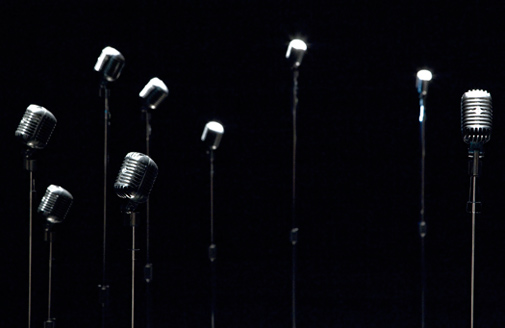
image
Artist: Rafael Lozano-Hemmer 

Produced & released in 2008 The work of art is shown in an exhibition, Souls and Machines, in Madrid in Spain. 

Description of Microphones: 

  • It enacts the idea of an invisible stage. The audiences do not know who’s the voice is. 
  • It is an interactive installation featuring one or several 1939-Vintage Shure microphones, placed on mic stands around the exhibition room at different heights. It suits anyone form different heights. 
  • There is a spotlight shining on each microphone. It creates the stage for giving speech.  The microphones were modified. They are connected to a network of hidden control computers and a tiny loudspeaker.
  •  Purpose to encourage people to speak and feel free to talk with public. 
  •  Create the sense of ‘Talk Back’. 


How the Microphones work? 

  • When the audiences speak into the microphone, the computer records the voice and immediately plays back the voice of a pervious participant, as an echo from the past. 
  • Half the time the microphones play back the voice that was just recorded, while the other half they reproduce a recording at random from up to 600,000 that microphone can store. Interesting & thought-provoking parts of the artwork:
  •  It is an opportunity to encourage people to express their own thinking to the public. 
  • The event and audience participation--------Audience must participate in the artwork. Audience is the most important element of this artwork.
  • The concept rather than the art object---------The artwork is not only the modified microphones but also the participation of the audiences.
  • An interest in events--------play back the pervious voice of participant create an interesting effect of encouraging to speak more. The audiences use the artworks to play some games.
 Quotes:
 1. “The spoken word, however, has a much stronger physical presence than any projected imaged or text. Nothing speaks louder than a person who steps up to a microphone onstage under spotlight. The microphones is the embodiment of public speech.”

P.198 Frieling, Rudolf, and San Francisco Museum of Modern Art. 2008. The art of participation :1950 to now. New York: Thames & Hudson

 2. “People initially only say something short like "hello" or "I am the decider" but as they realize that the resulting echo is actually recordings from previous participants they start giving longer speeches, they sing, or the play "exquisite corpse".”

 “Microphones” Rafael Lozano-Hemmer. http://www.lozano-hemmer.com/microphones.php (accessed Nov. 20,2013). 


An evaluation of the work in terms of the issue I have chosen to focus on Networked Digital Art 
An example of networked digital art Desktop Theatre

  • was a project created by Adriene Jenik and Lisa Brenneis 
  • ran from 1997 to 2002 
  • consisted of a series of early experiments in network performances using online discussion rooms and visual chat applications 
  • was to introduce a compelling way for the public to interact with theatre.
  • Everything that could be seen on stage live or through online performances was compressed into 2D and computer speech.

 Desktop Theatre shares with art movement
  •  makes art being interesting. ------- the characters can have different gestures, emotions and speech.
  •  The concept rather than the art object-------It is an online theatre that generate a new concept of visual chat room (online chat spaces using avatars and computer graphic backgrounds).


  • Audience participation------There are three set of participants

  1.   Lurkers, audience members who hang out and watch
  2.  Supers, audience members who participate in the chat room talking to each other and to the:
  3.  Players, ”lead actors” who play the roles in the roles in the linear script and interact with supers 


 Rudolf Frieling and San Francisco Museum of Modern Art, The art of participation :1950 to now, (New York: Thames & Hudson, 2008), 212.

Friday, 25 October 2013

Mark Napier's Shredder


Here is Mark Napier's Shredder
http://www.potatoland.org/shredder/

Shredder is typical of much digital art because it is an artwork that places importance on

1. Formal instructions
Shredder has clear instructions to teach people how to use the website. The audiences put a link on it and it generate picture which shows the website in different way.


2.The concept rather than art object
The concept of Shredder is to"present the global internet structure as a chaotic, irrational, raucous collage." The idea is important part of the artwork rather than the images shown.

3.The event and audience participation
Audience can freely choose the links to put on and there will be different consequence.

4.An interest in random events or chance
When you put a link on it, Shredder shows the web in a random way.

5.Borrowing or appropriation
It appropriates the data of the web in order to transform it. In other words, it has to borrow other web sites to finish the images.

Friday, 11 October 2013

 Pros and cons of playing video games for individual and societies:

Pros:
1.People can gain knowledge from these games
2.People can express their feeling in the games world
3.Entertainment and relaxing
4.It is training for people to gain skills and techniques
5.Earning money

Cons:

1.Isolation between players and their family
2.Players cannot distinguish between real world and games
3.Some games are immoral which are violent, sexual and gambling games


The evidence that digital games can encourage aggressive values and anti social actions in the real world


There are many shooting games in America. The teenagers may be affected by these games and feel that shooting others is exciting. This may be a cause of why there are many school shooting in USA.


Should government have the right to ban  certain game/place age restrictions on it


I think that the age restriction should be placed on these games  because the teens may be affect by these games and having a bad effect on it.

Tuesday, 1 October 2013

Video Game: Counter-Strike

What is 'Counter-Strike'?
Counter-Strike is a tactical first-person shooter video game.Players can play as neither the terrorist team ,the counter-terrorist team and play the of a team of terrorists against a team of counter- terrorists in a serious of round. Players have to finish the mission objective or eliminating the opposite side.Players can choose to play as one of  the character models.

HERE is video of Counter-Strike


Can it be classified as art?
According to Adams, Art should contain some features.
1. Art as expression, representational, it should contain some messages.
2. Art should be long lasting.
3. Art should be the media to link between artists and audience, there should be an interaction.
4. Art contain aesthetic quality.
5. Art can provoke emotion.
6. Art should not be formulaic,but innovative.

Considering the above features, Counter-Strike cannot be classified as art.

First I want to say is that the game is too violent and  is against moral value. Players won by killing all the members of  opposite team. It encourages people to use violence to get the goal.

Secondly, the game is not the media to between editor and audience. However, it provides a space for audiences(players) interact with each other.

Moreover, it considers  the visual elements of the game . The pictures of the game are not beautiful. The pictures are following the same pattern.


However, the Counter-Strike can meet some of the features which mentioned above.

Counter-Strike is lasting for over ten years. The units of sale in the ten years is over 25 millions.

Players can create their own map of the game.
HERE is the map which created by players

The map is the mixture of Super Mario and Counter-Strike.

Monday, 30 September 2013

27/9/2013 Group discussion : should games be considered as art?

Group discussion: Should video games be considered as art?


Date: 27/09/2013 Fri


What is art ?


We all agree that:


1.      Art should be expressive, representational, and able to reflect the artists’ idea/philosophy


2.    It can provoke human’s feeling and thinking.


3.    It contains aesthetic qualities ( visual elements)


4.    Creative/ innovative


Some of us think that:


1.      Narrative( except immoral issues like violence and sex while some disagree that art must be moral)  while some think that art need not to be narrative and abstract like Jackson Pollocks’s painting.


2.      Educational, it can bring some new knowledge to the audience or let the audience to know something they didn’t know before


3.      Entertaining


Adams’ s definition of art and our opinions


1.      As an expression, representational


-Most of us agree with some points made by Adams that art should be expressive as art should be the media to transfer the message of artist to the audience while some think that art should be personal and private, the philosophy of artists need not to be transferred to public or let the others know.


2.      Long lasting


-Some agree with Adams that art should be long lasting while the others think that the ‘long lasting artwork’ means well-known and master piece but there are some work that are not long lasting and not be known by the people after many years but they are still art.


3.      Interactive


-We all think that there should be some interaction between the artwork and the audience so that the audience can get what the artists want to convey by the work.


4.      Make the statement/ have its own contents 


5.      Contains aesthetic qualities (visual element/ design)


-We all agree that art should bear some aesthetic qualities and we can use formal analysis to analyze them by considering its color, lines, space, composition etc.


6.      Make the audience think/ feel something


-we think that art should create some emotion in the audiences, the feeling or emotion can be positive, negative or neutral.


7.      Innovative but not formulaic


-Most of us agree that art should be creative and formulaic. But some think that art can be formulaic by considering the example of film. Some would judge whether the film is good or not, commercial or independent, etc, but they would consider the formulaic Hollywood films also are the kind of art.

Friday, 13 September 2013

Eric Siu ~Touchy~

 
I think Touchy is a great project to encourage interaction among people. Participants need to touch "Touchy" for ten secords in order to take a photo. It is a interesting idea for me.=D
 
HERE is the viedo: