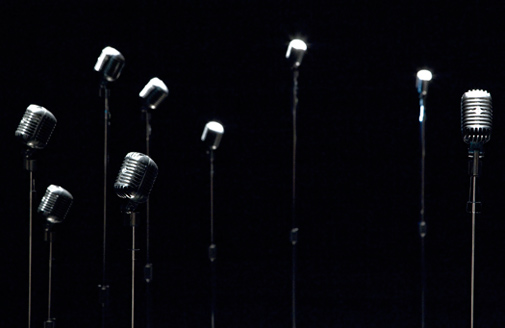
Artist: Rafael Lozano-Hemmer
Produced & released in 2008 The work of art is shown in an exhibition, Souls and Machines, in Madrid in Spain.
Description of Microphones:
- It enacts the idea of an invisible stage. The audiences do not know who’s the voice is.
- It is an interactive installation featuring one or several 1939-Vintage Shure microphones, placed on mic stands around the exhibition room at different heights. It suits anyone form different heights.
- There is a spotlight shining on each microphone. It creates the stage for giving speech. The microphones were modified. They are connected to a network of hidden control computers and a tiny loudspeaker.
- Purpose to encourage people to speak and feel free to talk with public.
- Create the sense of ‘Talk Back’.
How the Microphones work?
- When the audiences speak into the microphone, the computer records the voice and immediately plays back the voice of a pervious participant, as an echo from the past.
- Half the time the microphones play back the voice that was just recorded, while the other half they reproduce a recording at random from up to 600,000 that microphone can store. Interesting & thought-provoking parts of the artwork:
- It is an opportunity to encourage people to express their own thinking to the public.
- The event and audience participation--------Audience must participate in the artwork. Audience is the most important element of this artwork.
- The concept rather than the art object---------The artwork is not only the modified microphones but also the participation of the audiences.
- An interest in events--------play back the pervious voice of participant create an interesting effect of encouraging to speak more. The audiences use the artworks to play some games.
1. “The spoken word, however, has a much stronger physical presence than any projected imaged or text. Nothing speaks louder than a person who steps up to a microphone onstage under spotlight. The microphones is the embodiment of public speech.”
P.198 Frieling, Rudolf, and San Francisco Museum of Modern Art. 2008. The art of participation :1950 to now. New York: Thames & Hudson
2. “People initially only say something short like "hello" or "I am the decider" but as they realize that the resulting echo is actually recordings from previous participants they start giving longer speeches, they sing, or the play "exquisite corpse".”
“Microphones” Rafael Lozano-Hemmer. http://www.lozano-hemmer.com/microphones.php (accessed Nov. 20,2013).
An evaluation of the work in terms of the issue I have chosen to focus on Networked Digital Art

- was a project created by Adriene Jenik and Lisa Brenneis
- ran from 1997 to 2002
- consisted of a series of early experiments in network performances using online discussion rooms and visual chat applications
- was to introduce a compelling way for the public to interact with theatre.
- Everything that could be seen on stage live or through online performances was compressed into 2D and computer speech.
Desktop Theatre shares with art movement
- makes art being interesting. ------- the characters can have different gestures, emotions and speech.
- The concept rather than the art object-------It is an online theatre that generate a new concept of visual chat room (online chat spaces using avatars and computer graphic backgrounds).
- Audience participation------There are three set of participants
- Lurkers, audience members who hang out and watch
- Supers, audience members who participate in the chat room talking to each other and to the:
- Players, ”lead actors” who play the roles in the roles in the linear script and interact with supers
Rudolf Frieling and San Francisco Museum of Modern Art, The art of participation :1950 to now, (New York: Thames & Hudson, 2008), 212.
